Promises Made, Promises to Be Kept
What New Canaan Told Its Own Citizens in 1967

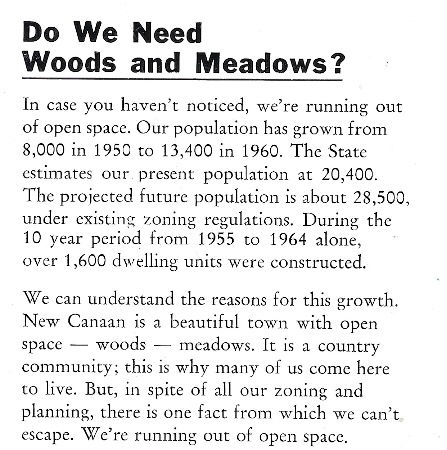
In the summer of 1967, the Town of New Canaan asked its residents to approve a bond issue to acquire 300 acres of woods and meadows from Mrs. Ruth Lapham Lloyd — the very land that would become Waveny Park. The brochure the town circulated to win that vote survives, and it is worth reading closely, because it is not a vague expression of civic sentiment. It is a list of specific promises.
The committee that authored it — chaired by Peter B. Emmons, with members Darwin DeLapp, Heywood Fox, J.D. Gunther, Robert M. Hart, and Allen M. Whitlock — told voters plainly what the land was for: picnicking "in peace and quiet," walks for strolling and bird-watching, horticultural exhibits, archery, tennis, softball, bridle paths, community and club meetings, an outdoor amphitheatre, and "other social, cultural and health-related activities." It emphasized that the buildings on the property — "of no value to a developer but of substantial value to our town" — would serve the community, not commerce. And it drew an explicit contrast: this land, preserved, versus this land, developed. Voters were told in black and white that development was the alternative being avoided, not a future option being reserved.
That contrast is the whole argument of the brochure. New Canaan was "running out of open space." The population had grown from 8,000 in 1950 to 20,400 by the brochure's writing, with 28,500 projected under existing zoning. The Lloyd-Lapham property was, in the committee's words, "the last available large tract of desirable land in New Canaan." Mrs. Lloyd could have sold to a developer for an estimated $2,500,000. She chose instead to sell a portion to the town at appraised value and gift the remainder — a decision the town met, in turn, with a promise: this land would be held for the public, for recreation, for open space, in perpetuity.
Nearly sixty years later, a portion of that same land — Parcel E — is the subject of a proposal to lease roughly 50 acres to Waveny LifeCare Network for a continuing care retirement community. The deed language attached to the original gift still speaks for itself: the premises are to be "held and used for purposes of recreation, health, horticulture, public park and gardens... the preservation and conservation of open spaces, bird sanctuaries, arboretums, and nature and equitation trails."
A CCRC is not on that list. It was not in the 1967 brochure's list either — it was, if anything, the very outcome the brochure asked voters to reject in favor of preservation.
Open space was recognized in 1967 as a valuable asset to the residents of New Canaan, and it continues to be one today. What the town understood then — that a growing community loses something irreplaceable when its last open land disappears — is, if anything, more true now than it was in 1967. New Canaan is more built out, more populous, and has less remaining open land than the committee could have imagined when they warned residents they were "running out of open space."
The town kept its promise for a long time. The question now is whether it intends to keep it going forward, or whether "in perpetuity" has an expiration date after all.